What AI changes on a property case: Where the standard has moved, and where it hasn't
AI is changing what counts as reasonable evidence on a property file. It is not changing who carries the judgement, or the liability. The difference matters for executors, deputies and the firms instructing them.
Most of what gets written about AI and the professions is written by people selling AI. The claim is usually about speed: the same work, done faster. On a property file, speed is the least interesting thing AI does. The more interesting thing, and the one worth a professional's attention, is what it does to the standard the work is measured against.
This is a question for anyone who carries a property through an estate or a deputyship: the executor, the insolvency practitioner, the deputy, and the firm instructing on their behalf. The question is not whether to be impressed by the technology. It is whether the bar for "reasonable steps" has moved, and what follows if it has.
The monthly snapshot
Until very recently, the evidence on an empty property file was a periodic thing. Someone attended, every so often, and a report followed. A few photographs, a note on condition, a meter reading if you were lucky. Between visits, the file said nothing, because nothing had been recorded.
That was the normal standard, and for years it was a defensible one. An unoccupied property policy typically requires an inspection logged monthly, so a monthly visit with dated photographs met the policy condition and, by extension, met what the market treated as reasonable. I wrote in an earlier piece in this series about how often a claim turns, much later, on whether that inspection log actually exists. The log was the evidence. The gap between the logs was simply accepted.
The trouble with a snapshot is the thing every probate practitioner already knows. The questions arrive late. A neighbour's claim, an insurer's query, a beneficiary asking where something went, a regulator's question at audit, all of these tend to land months or years after the event they concern. A snapshot taken in January is a thin answer to a question asked the following December. I have sat with a fee-earner going through a box of loose photographs, trying to work out which winter a particular ceiling stain belonged to, because an insurer had asked and the file could not say.
What actually changes
What AI changes is the spacing. The evidence on a file no longer has to be a periodic event. It can be current.
Three shifts sit underneath that. The first is currency: a file can reflect the state of the property now, rather than the state of the property at the last visit somebody got round to. The second is consistency: when the same things are checked the same way on every property, the evidence holds together across a whole caseload, instead of being thorough where someone was diligent and thin where someone was rushed. The third is volume, and it is the one that matters most while being the least discussed. A firm with forty live estates has always, in practice, been able to speak with real confidence about three or four of them, the ones that came up that week. The rest were carried on trust. Evidence that is current and consistent across all forty is a different operating position. The partner can answer for the whole caseload, not the part of it that happens to be front of mind.
Put those together and the effect is not really about technology. It is about the standard. When current, consistent evidence across an entire caseload becomes achievable, it slowly stops being exceptional and starts being expected. "Reasonable steps" is not a fixed quantity. It is a measure of what a competent professional could reasonably have done, and what a professional could reasonably have done has just moved. The SRA's 2024 Thematic Review on Probate and Estate Administration reads in the same direction: probate and estate administration is the third highest category for complaints to the regulator, and the direction of travel on third-party arrangements is more rigour, not less. I argued the same thing in the contractor liability piece. The capability exists, so the expectation follows it.
What this looks like in practice
That argument is abstract, so it is worth being concrete about what a current file actually buys.
Take coverage. Probate and deputyship property does not arrange itself conveniently. A firm's instructions land wherever the deceased or the protected party happened to live, so a caseload ends up scattered across the country and rarely near anything. The familiar failure is the property an hour past the edge of anyone's usual patch. It gets attended late, or attended by whoever could be found, and the rhythm slips. When the work is organised so the nearest field capacity is matched to each job, that stops being a problem the client ever sees. The estate in a far county is attended on the same schedule as the one down the road from the office. Coverage stops being a matter of luck or geography.
Take the chattels. Every probate practitioner has had the conversation where a will leaves a named item to a named beneficiary and nobody can establish whether the item is still in the house. Reconciling an inventory against the gifts a will makes is slow clerical work by hand, and on a full house it is the kind of work where something gets missed. Done well, it is close to instant. Every gift the will makes is either matched to a photographed item or flagged as unmatched, and the solicitor opens the file to a checklist rather than a hunt. The necklace named in the will and not found in the house shows up as an amber flag on day one, rather than as a problem discovered the week before distribution.
I want to be precise about what is happening there, because a probate solicitor's first instinct, rightly, is to be careful about anything that goes near a will. The work is cross-referencing, not interpretation. The matching is clerical. What a clause of the will means, and what to do about a bequest that cannot be matched, stays the solicitor's reading and the solicitor's decision. The reconciliation surfaces the question faster and more completely than a person working through it by hand. It does not answer it.
Neither the coverage nor the chattels reconciliation is something generic software hands you. They exist because the system behind them was built for this work and nothing else, for probate and Court of Protection estates in England and Wales. A system designed around the actual shape of the work picks up what matters on these files, the named bequest with no item against it, the estate scattered miles from anywhere, because those were the problems it was built to solve. A platform built for sales teams and given a probate skin was built to solve something else.
What it does not change
It is worth being just as clear about the other half, because the technology is routinely sold as though there were no other half.
AI does not attend the property. Someone still has to walk the building, open the doors, find the slipped slate and the damp patch and the window that has been forced. The report is only ever as good as the attendance behind it, and attendance is physical work done by people who have to be there.
AI does not make the judgement. A report can tell a deputy that a property's condition has changed. It cannot decide whether that change calls for an urgent repair or simply a line on the file. That decision is the deputy's, it is made against the OPG's Deputy Standards, and the deputy answers for it. The chattels reconciliation is the same: it can show a solicitor that a bequest is unmatched, but what that means for the estate belongs to the solicitor. The same holds for the executor weighing a cost against the estate, or the insolvency practitioner deciding what a creditor needs to see.
And AI does not carry the liability. This is the part that does not move at all. When something goes wrong on a property, the question is still who held the duty, and the duty still sits on the appointed professional. A report is evidence. It is not a decision, and it is not a defence on its own. The OPG still audits the deputy. The SRA still takes an interest in the firm. The executor still holds a personal exposure that runs for years after the death.
I want to be careful here, because this is where the genuine risk sits. The risk is not that the technology is overhyped. It is that a busy professional starts to treat the output as the judgement: sees the green ticks and files the report as though the thinking has been done. It has not. The report has made the evidence better. The professional still has to read it and decide what it means.
A stake in the ground
AI is changing what counts as reasonable evidence on a property file. It is not changing who is responsible for the property. Those two facts are easy to state, easy to run together, and running them together is the mistake.
In my view, the professional who benefits from this is the one who treats it as a way to raise the floor of their evidence, not as a way to step back from the file. The evidence gets better, more current and more consistent, and that is worth having on its own terms. It is worth having for a second reason too. The standard the file will be judged against is rising whether or not any individual firm adopts the tools. That is the point I would underline. The bar for reasonable steps does not wait for a firm to be ready. It moves when the capability becomes general. A firm still working to a monthly-snapshot standard in three years' time will not be exposed because it failed to buy software. It will be exposed because the rest of the field moved and it did not.
The judgement, though, the decision about what the evidence means and what to do about it, stays exactly where it has always been. That is not a limitation of the technology to be fixed in a later version. It is the part of the work that is the profession. The report gets better. The professional is still the professional.
I would be interested to hear from solicitors and professional deputies on this, and from insolvency practitioners carrying property on the file. Whether you recognise the monthly-snapshot standard from your own files, or whether you have already changed what you expect a property report to tell you. You can find me at [email protected] or on LinkedIn.
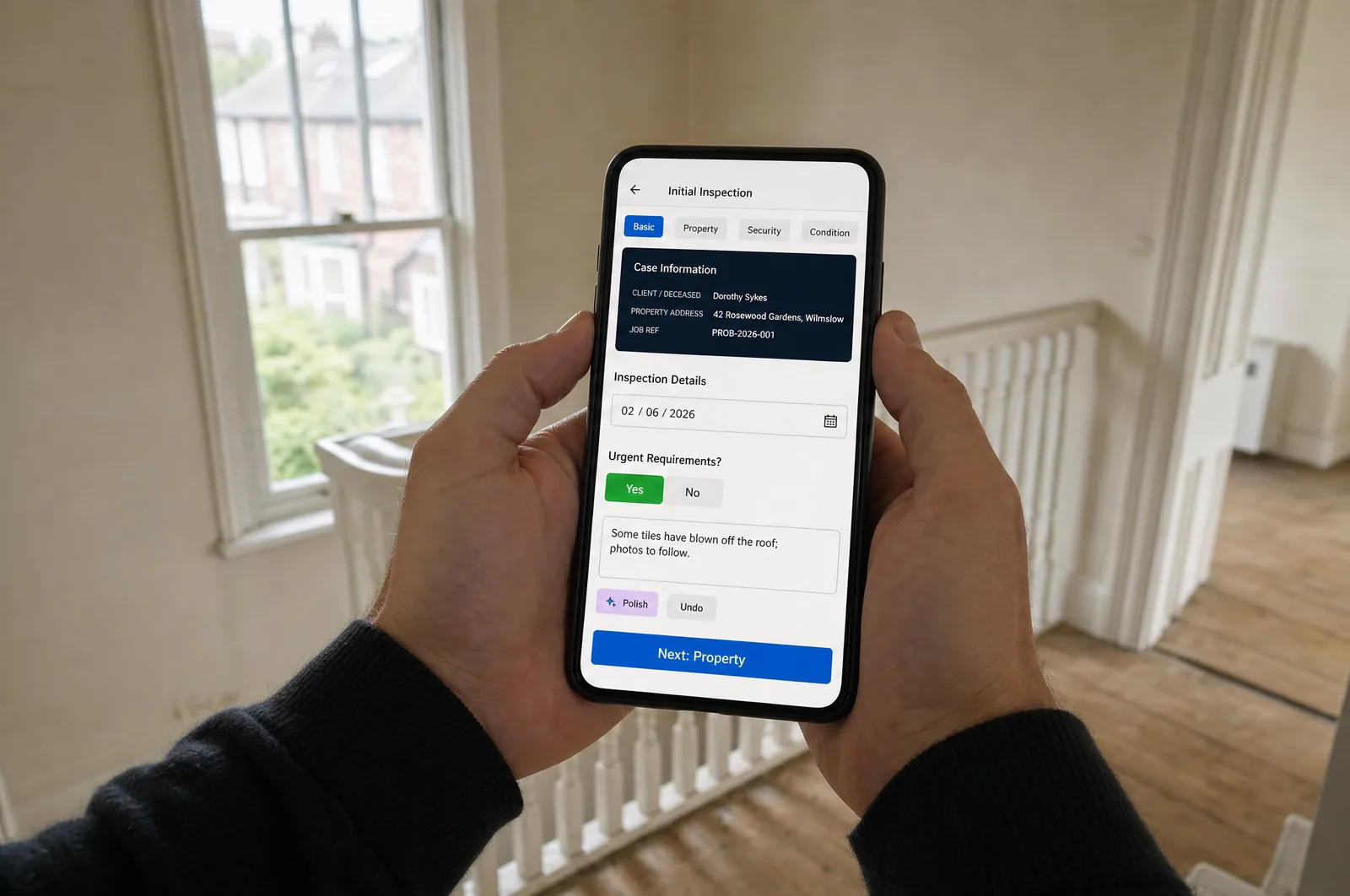
At Prospect PS we built our reporting to be current rather than occasional, because we think the standard for reasonable evidence on a property has already moved.

Managing Director, Prospect PS Ltd
David Halliwell is Managing Director of Prospect PS Ltd, a UK property management company working with solicitors, professional deputies, insolvency practitioners, and local authorities. Prospect PS provides end-to-end property management for probate, Court of Protection, insolvency, LPA receivership, and local authority empty homes across England and Wales. Every case is managed in-house to a consistent standard, with all contractors vetted for compliance and security before they enter a property. Reporting is AI-driven, producing a structured, timestamped record from first instruction to final disposal.