When a borrower defaults: Who is actually looking after the property
When a borrower stops paying and the file moves to recovery, the house sits in a gap nobody clearly owns. The recovery process is built to manage the debt, not the building.
A question for anyone who lends against residential property. When a borrower stops paying and the file moves to recovery, who is actually looking after the house?
It sounds like it should have an obvious answer. In practice it rarely does. The file moves from arrears management to a recovery team, perhaps to solicitors, perhaps to a receiver. Each of those people has a clear job, and none of those jobs is the building. The arrears team is chasing the debt. The solicitors are getting the order. The receiver, once appointed, is there to realise value. The property itself, the physical thing with a roof and a front door and a heating system, sits underneath all of that, and for a stretch of weeks or months it belongs to a process rather than to a person.
That gap is where the avoidable losses live.
The window before anyone is appointed
Default is not a single event. There is a borrower who has stopped paying, a forbearance period, a notice, possibly a possession hearing, and only then an order or an appointment. Across that timeline the property can quietly empty out. The borrower hands the keys back, or stops living there, or leaves before anyone formally takes control. Nobody schedules an inspection because, on paper, nobody yet has the standing to.
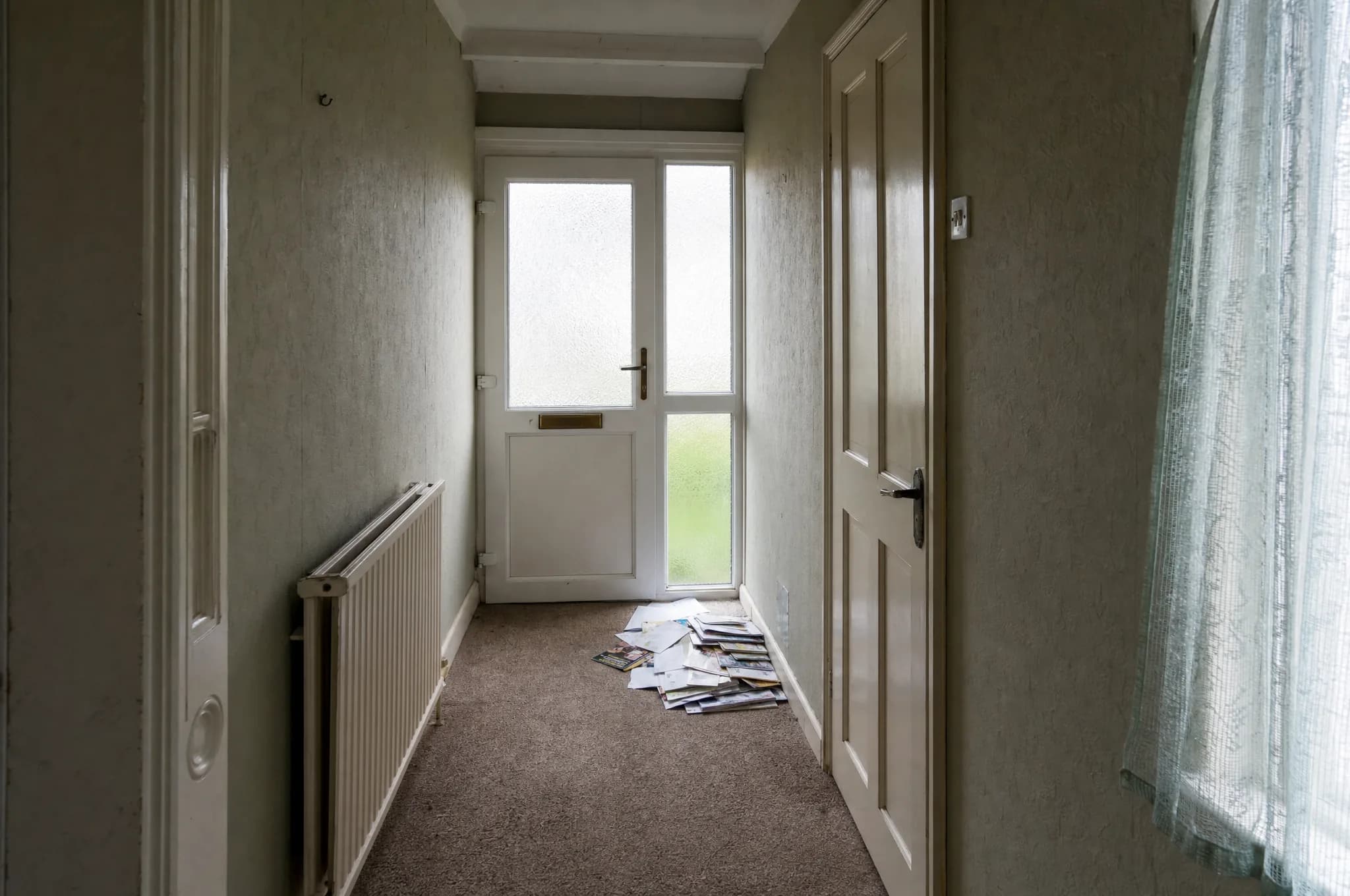
I have stood in repossessed houses where it was plain that nobody had been through the door in months. Post on the mat, a tripped consumer unit, a slow leak under a sink that had been running long enough to lift the floor. None of it was dramatic at the point it started. All of it was cheaper to prevent than to put right.
The lender's instinct in that window is reasonable: do not take possession before you have to, because possession brings duties with it. But the practical effect is that the asset securing the loan is sitting vacant and unmonitored at exactly the moment its condition is most exposed, and the file has no line in it for who checks.
What an LPA receiver actually is, and is not
When a fixed-charge or Law of Property Act receiver is appointed, a lot of lenders quietly assume the property is now handled. It is worth being precise about what the appointment does.
Under section 109 of the Law of Property Act 1925, the receiver is the agent of the borrower, not of the lender. That structure exists to keep the lender at arm's length from possession liability, and it works. But it also means the receiver's primary statutory job is to collect income and apply it in the order the section sets out: outgoings and prior charges first, then the receiver's own commission and insurance, then interest, then principal. On an empty residential property in default there is usually no income to collect. The machinery the statute hands the receiver is built around rent that, here, does not exist.
Insurance is the sharpest example. The same section says the receiver shall insure the property, but only "if so directed in writing by the mortgagee." Absent that written direction, the statutory duty to insure does not bite. So you can have a vacant property, a receiver appointed, and no live instruction in place to insure it, with every party assuming one of the others has it covered. UK Finance's own guidance for lenders is clear that the receiver's powers are a starting point that the appointing lender has to actively shape. The appointment is a set of powers, not a guarantee that the building is being looked after.
The duty that does attach to the asset
There is one duty that runs through this whole process and points straight at the condition of the property, even though it is usually discussed only in terms of price.
When the power of sale is exercised, the receiver or mortgagee owes a duty to take reasonable care to obtain the true market value of the property at the point of sale. That is Cuckmere Brick Co Ltd v Mutual Finance Ltd [1971], and it has been the working standard for over fifty years. The case is remembered as an advertising point, because the land was marketed without mentioning a valuable planning permission and sold for around forty-four thousand pounds against an argued seventy-five. The principle is broader than the advert. You cannot obtain the true market value of an asset you have allowed to deteriorate while it sat waiting to be sold.
This is where the condition question and the value question turn out to be the same question. A property that is marketed with a damp-stained ceiling, a dead heating system and visible signs of an empty house is not being sold at its true market value, whatever the brochure says. The duty is framed around the sale, but it is earned or lost in the months before the sale, in whether anyone was maintaining the thing. Cuckmere tells a receiver to get the best price reasonably obtainable. It is very hard to argue you did that if the file shows the property was left to decline on your watch.
The clocks do not pause for the process
While the recovery process works through its stages, the property is running to a different set of timetables that do not care which stage the file is at.
Most unoccupied property hits an insurance cliff at thirty days. Standard buildings cover falls away or narrows sharply once a property is empty beyond that point, and the cover that replaces it carries conditions: regular documented inspections, services drained down, sometimes a security standard on the locks. Council tax is its own meter, and since the April 2024 changes councils can apply a premium of up to one hundred per cent on dwellings empty beyond twelve months, which on a property stuck in a slow recovery is a real number landing on the eventual recovery position. Security is the third clock, and an empty house that looks empty is the one that attracts the broken window and the uninvited occupant.
I wrote about how these three timetables interact on probate property in an earlier piece in this series, and the mechanics are the same here. The cause of the vacancy is different. The exposure is identical. So is the answer that does not work, which is assuming that because nothing went wrong on the last file, nothing will go wrong on this one.
I want to be careful here, because none of this is the receiver doing their job badly. A receiver appointed to realise an asset is operating exactly as the statute and the appointment intend. The point is narrower. The recovery process is designed to manage a debt, and a debt is not a building. Nobody in the standard chain is funded, instructed or scheduled to treat the property as a thing that needs looking after between the day it empties and the day it sells. That is a gap in how the work is set up, not a failing of any one party in it.
Where this leaves the lender
In my view, the property side of a default needs to be treated as its own workstream from the day the file moves to recovery, not picked up as an afterthought once a sale is being arranged. The recovery of the debt and the preservation of the asset securing it are the same commercial interest, and at the moment they are managed as if they were separate problems owned by different people.
That means a named instruction for who inspects, who insures, who secures and who holds the keys, in writing, at the point of default rather than at the point of sale. It is not expensive relative to what it protects. A documented inspection regime and a live unoccupied policy cost a fraction of one burst pipe, and they are the difference between a property that sells at its true market value and one that does not. The damage does not even need a contractor to cause it, though when one is instructed in this window the exposure compounds, as I set out in an earlier piece on contractor liability.
A stake in the ground
The recovery process is built to manage the debt. The asset securing that debt is a building, and a building left vacant and unmonitored deteriorates on a timetable that does not wait for the order, the appointment or the sale. Until the property is treated as its own workstream with a named owner from the day of default, every defaulted residential loan is carrying a second loss the file does not show, sitting quietly behind the one it does.
I would be interested to hear from lenders, LPA receivers and asset managers on this. Whether you recognise the gap from your own files, or whether you have a protocol that closes it earlier than the ones I usually see. You can find me at [email protected] or on LinkedIn.
At Prospect PS we treat the property as its own workstream from the day of default, because the duty to obtain its true value is earned in the months before the sale, not at the auction.

Managing Director, Prospect PS Ltd
David Halliwell is Managing Director of Prospect PS Ltd, a UK property management company working with solicitors, professional deputies, insolvency practitioners, and local authorities. Prospect PS provides end-to-end property management for probate, Court of Protection, insolvency, LPA receivership, and local authority empty homes across England and Wales. Every case is managed in-house to a consistent standard, with all contractors vetted for compliance and security before they enter a property. Reporting is AI-driven, producing a structured, timestamped record from first instruction to final disposal.