
Best interests on the ground: What DoLS actually means when there's a propane bottle in the shed
A Court of Protection clearance turns up propane bottles and petrol cans at a property no storage provider will touch. 'Don't dispose of anything' is not a best interests decision when the law of hazardous waste says otherwise.
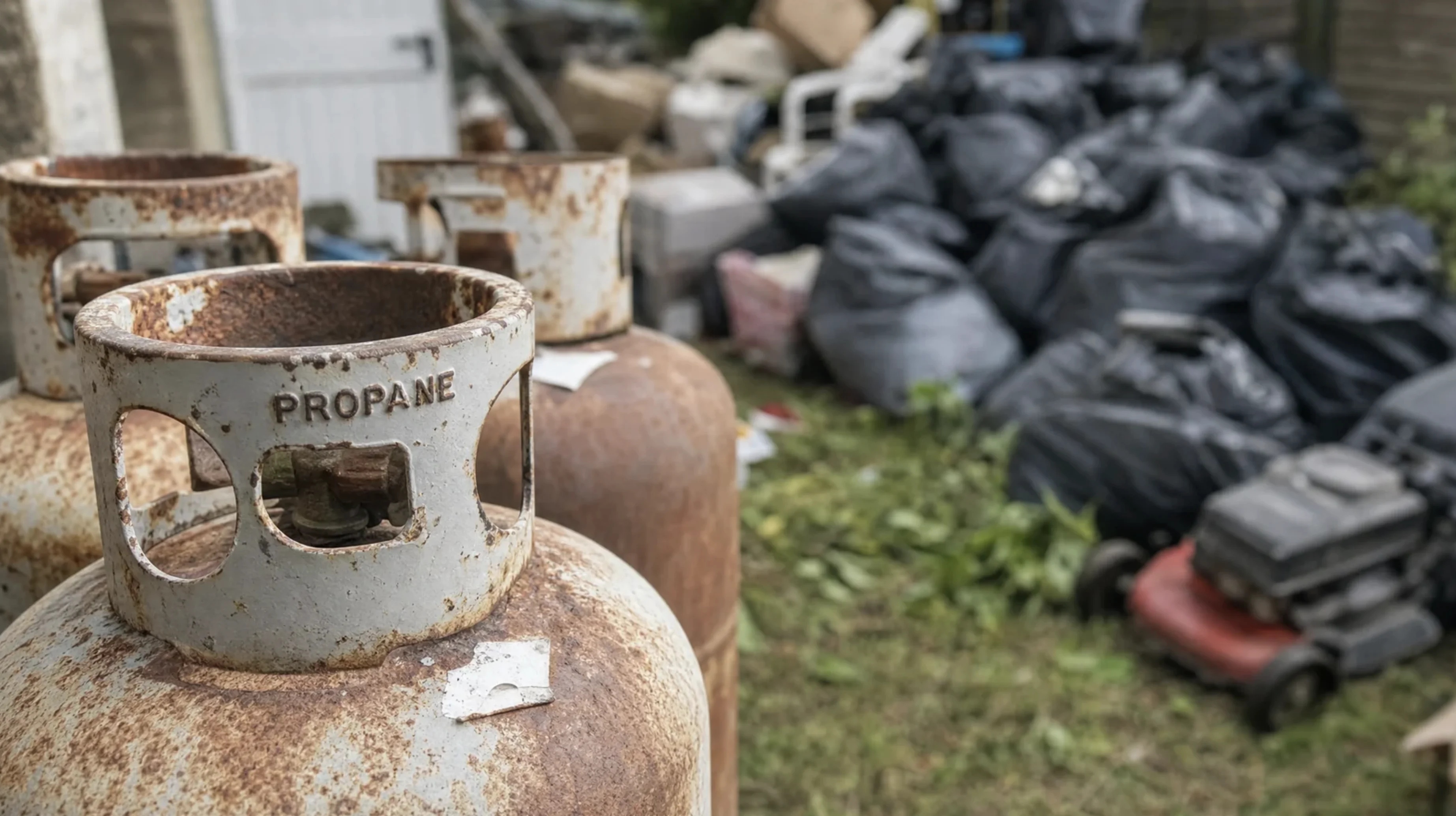
The property in south-east London had been empty for three years. The client went into care and stayed there. The house was full, not just untidy, but full in the way that happens when someone has been accumulating things for decades and then leaves without clearing anything. The garage and two sheds were worse. Four lawnmowers, a generator, propane bottles, petrol cans. None of it maintained. All of it sitting there since the client left.
We were instructed to carry out a clearance. The client is subject to a DoLS authorisation. There is no LPA in place. The message from the instructing solicitors was, broadly, the one we hear in some form on most CoP cases: you cannot dispose of her belongings without authority.
That position is correct. It is also incomplete. And the gap between what it says and what it actually requires on the ground is where the risk sits.
What the DoLS framework says about property decisions
A Deprivation of Liberty Safeguards authorisation does not directly govern what happens to a client's possessions. DoLS authorises the deprivation of liberty in a care setting; it does not create a blanket prohibition on managing, maintaining or disposing of items at a property the client is no longer living in. But the Mental Capacity Act 2005, which sits underneath all of this, does govern property decisions made on behalf of someone who lacks capacity.
Under section 4 of the MCA, anything done for or on behalf of a person who lacks capacity must be done in their best interests. The best interests test is not a substituted judgement test. It does not simply ask what the person would have wanted. It requires consideration of all relevant circumstances. All of them. Including the circumstances in which the decision is being made.
The OPG's 2023 Deputy Standards, which apply to professional deputies appointed by the Court of Protection, are explicit that property management is a core deputyship function. Standard 6 covers property management directly. The standards require deputies to record significant property decisions and the reasoning behind them. They do not require deputies to hold onto everything indefinitely on the grounds that disposal might not be what P would have wanted.
That distinction matters.
Why storage is not an option
When we encounter hazardous materials on a CoP clearance, the instinct from the legal side of the instruction is often to treat storage as the neutral holding position. Put it in storage, keep it safe, deal with it later when there's more clarity on the estate or the client's wishes.
It's a reasonable instinct, and it's wrong for a reason that has nothing to do with the MCA.
The major commercial self-storage providers in the UK, without exception, prohibit the storage of flammable materials, hazardous substances, pressurised vessels and waste under their standard terms and conditions. Petrol cans, propane bottles, a generator with residual fuel: none of those items will be accepted. This is not a matter of negotiation or a question of finding the right provider. It is a contractual prohibition that exists because of fire risk, insurance conditions and the safety of other tenants in the facility.
With storage off the table, the realistic options narrow to lawful disposal or leaving hazardous materials sitting in an unsecured property.
What the law says about leaving them there
The Environmental Protection Act 1990 imposes a duty of care on anyone who produces, handles or is responsible for controlled waste. That duty does not pause because the property is subject to a CoP order. Propane bottles are pressure vessels and a fire risk. Petrol in old cans degrades, produces vapour, and becomes a source of ignition. A generator with residual fuel sitting in a domestic garage for three years is not a neutral item. Neither is the property around it: an empty property carries its own running costs and exposures regardless, and we have set out before how the insurance, council tax and security clocks run on every vacant probate property. A clearance that uncovers hazardous materials only adds a faster one.
The Hazardous Waste (England and Wales) Regulations 2005, amended in 2016 but unchanged in their core duty of care obligations, require that hazardous waste is transported and disposed of by licensed carriers with appropriate consignment documentation. Anyone who holds hazardous waste and fails to ensure its proper disposal is in breach of those regulations. The client's lack of capacity does not shift that duty onto her; it stays with whoever is managing the property on her behalf, and by implication with the solicitors who gave the instruction.
A house clearance is rarely a single waste decision, and the regulation does not stop at the obviously dangerous items. The upholstered seating falls under the Environment Agency's rules on persistent organic pollutants: since January 2023, waste domestic seating that may contain POPs must be kept separate from the rest of the load and sent for incineration. It cannot go to landfill, and it cannot be recycled or passed on for reuse. A fridge is a separate stream again. Each of these has its own handling cost. On a clearance we are running now, three vans and six staff on site, the special-disposal charges passed eight hundred pounds before the bulk of the ordinary refuse had been moved. The figure itself matters less than what it shows: the cost of dealing with a property's contents properly is already running, every week, whether or not anyone has authorised it.
Where best interests actually lands
Here is the question worth asking directly: is it in the client's best interests to leave propane bottles in a shed in south-east London for another twelve months while the legal side of the case is worked through?
The MCA's best interests test requires consideration of all relevant circumstances. The relevant circumstances here include the fire risk to the property, the liability exposure to the estate, the environmental duty of care under the 2005 Regulations, and the simple fact that no storage provider will take these items. "Don't dispose of anything" is not a best interests decision. It is the absence of a decision, presented as a position.
I think there is a professional habit, understandable and well-intentioned, of treating caution as the safe option in CoP cases. Keep everything. Defer everything. Wait for the court's view. But caution applied to hazardous materials stops being caution. A propane bottle left in a shed is its own risk, just a slower and quieter one. A fire at the property, damage to neighbouring properties, a claim against the estate, a regulatory notice from the Environment Agency: none of those outcomes serve the client's interests. Any of them could flow from the decision to leave things in place.
The correct approach is to distinguish between items that cannot be safely retained or stored and items of genuine personal or financial value that should be photographed and held pending further instruction. Those are two different decisions, and they should not be collapsed into one.
Personal effects, documents, jewellery, furniture with potential sentimental value: photograph them and retain them. Petrol cans and propane bottles: use a licensed waste carrier and keep the consignment notes. That is what best interests looks like when it has to work on the ground. It is also the same principle that governs who gets instructed to work on a probate property in the first place: competence and a paper trail are what protect the estate.
A framework that doesn't yet exist
What this case in south-east London made clear to me is that there is no standard framework for this decision. CoP practitioners deal well with the legal analysis. The OPG Deputy Standards cover property management at a headline level. But nobody has written up the practical decision tree for what to do when a clearance hits hazardous materials on a case where the client lacks capacity and the solicitors are understandably cautious.
That gap is where instructions stall. Clearance teams wait for authority that solicitors are reluctant to give, because giving it feels like a risk. Meanwhile the propane bottles sit in the shed.
A stake in the ground
Hazardous materials on a Court of Protection clearance are not a decision the legal timeline can be left to outlast. Leaving propane bottles and petrol cans in an unsecured property is a decision in itself, even when it is dressed as caution. The risk of acting, properly, lawfully, with documentation, is almost always smaller than the risk of not acting. The Hazardous Waste Regulations exist precisely to create a clear, auditable route for these decisions, and a consignment note from a licensed waste carrier is better evidence of a choice made in the client's interests than a year's worth of emails about why nothing was moved.
I would be interested to hear from CoP practitioners on this. Whether you recognise the stand-off between a cautious instruction and a property full of hazardous material from your own files, or whether you have a decision framework that handles it better than what I have set out here. You can find me at [email protected] or on LinkedIn.
At Prospect PS we treat hazardous materials on a clearance as a documented disposal decision rather than a holding problem, because the consignment trail is the clearest evidence that the decision was made properly and in the client's interests.

Managing Director, Prospect PS Ltd
David Halliwell is Managing Director of Prospect PS Ltd, a UK property management company working with solicitors, professional deputies, insolvency practitioners, and local authorities. Prospect PS provides end-to-end property management for probate, Court of Protection, insolvency, LPA receivership, and local authority empty homes across England and Wales. Every case is managed in-house to a consistent standard, with all contractors vetted for compliance and security before they enter a property. Reporting is AI-driven, producing a structured, timestamped record from first instruction to final disposal.